
LEARN
Class G VFR Weather Minimums
Class G is uncontrolled airspace, and it is almost never labeled. The sectional shows the floor of the Class E above it. Everything below that floor, down to the surface, is Class G. The oral question is rarely “point at the Class G.” It is “what weather do you need there, and when does that change?”
Those numbers come from 14 CFR 91.155. They depend on whether it is day or night, and on whether you are within 1,200 feet of the surface. Memorize the airplane table. Then use the chart to decide which row you are in.
Uncontrolled does not mean no rules
“Uncontrolled” means air traffic control is not controlling that airspace. It does not mean you may fly in any weather, skip cloud clearance, or ignore see-and-avoid.
You do not need a clearance or two-way radio just to fly VFR in Class G. You also do not get separation from other VFR traffic. You are responsible for seeing traffic and for meeting the weather minimums for the altitude you are actually at.
The chart still matters, because a climb of a few hundred feet can put you in Class E, where the minimums jump.
Where Class G ends on the chart
Class G is the airspace left over under Class E. Find the Class E floor first. The Class E sectional guide is the symbol-by-symbol version. The short version:
- Dashed magenta around the airport: Class E to the surface. There is no Class G inside that line.
- Dashed blue: Class D to the surface, not Class G.
- Magenta vignette: Class G from the surface up to, but not including, 700 feet AGL. Above that you are in Class E.
- No vignette, over most of the continental United States: Class G from the surface up to 1,200 feet AGL, then Class E.
- Blue vignette, mostly in the West and Alaska: Class G up to 1,200 feet AGL inside the fade. Outside it, Class G can continue until Class E begins at 14,500 feet MSL.
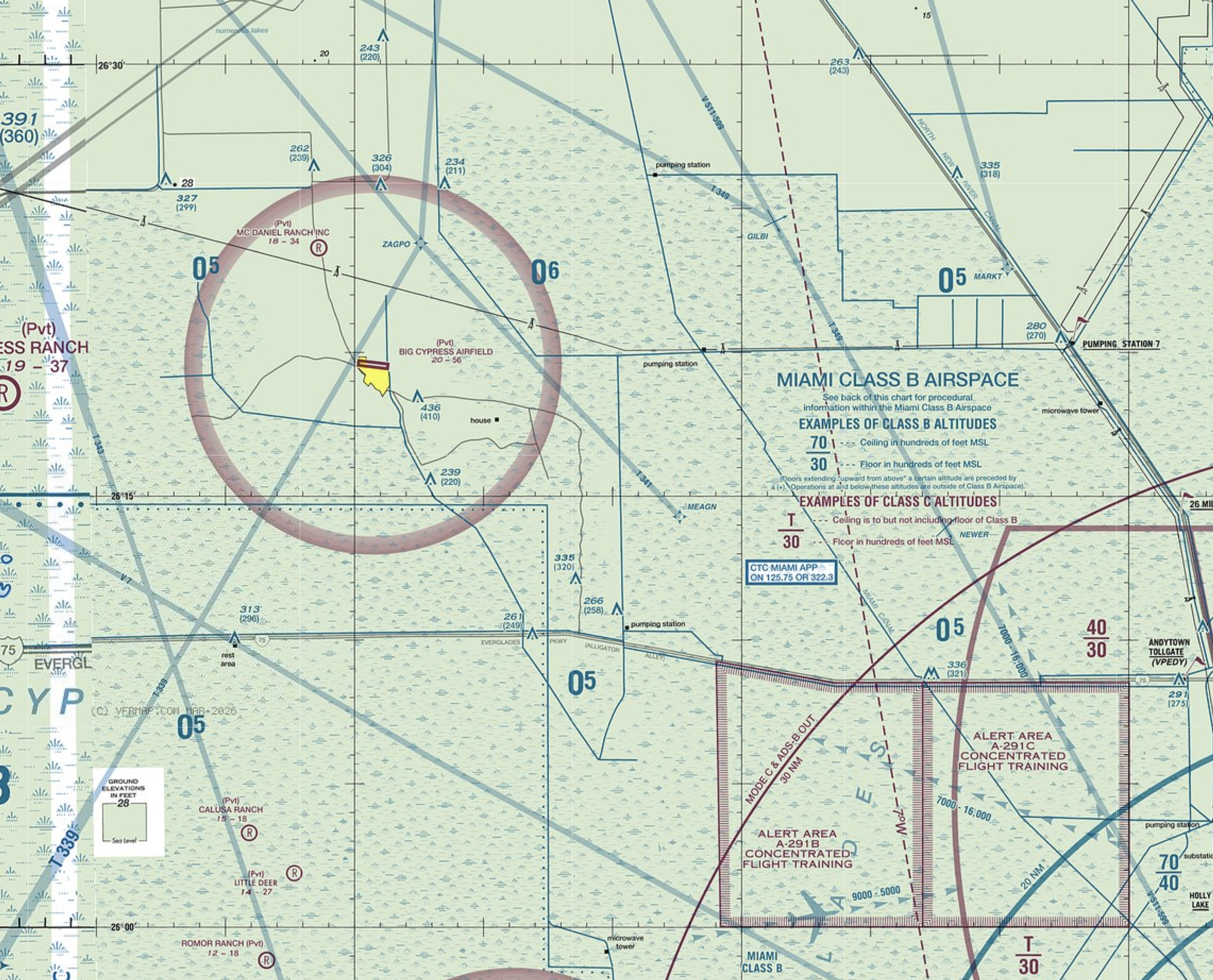
One regulation detail changes the answer at the exact altitude of the floor. For weather minimums only, 14 CFR 91.155(e) says an aircraft at the base of a Class E area is treated as if it is still in the airspace below. At 700 feet AGL inside a magenta vignette, use the Class G numbers, not the Class E numbers. One foot above that floor, you are in Class E.
The airplane numbers
These are flight visibility and distance from clouds for airplanes. Helicopters have their own, lower minimums in Class G. If the oral says “airplane,” do not give the helicopter answer.
Day, 1,200 feet AGL or below. 1 statute mile, and clear of clouds.
Night, 1,200 feet AGL or below. 3 statute miles, and 500 feet below, 1,000 feet above, 2,000 feet horizontally from clouds.
Day, above 1,200 feet AGL and below 10,000 feet MSL. 1 statute mile, and 500 / 1,000 / 2,000.
Night, above 1,200 feet AGL and below 10,000 feet MSL. 3 statute miles, and 500 / 1,000 / 2,000.
Above 1,200 feet AGL and at or above 10,000 feet MSL. Day or night: 5 statute miles, and 1,000 feet below, 1,000 feet above, 1 statute mile horizontally. This row is uncommon in the East, where Class E usually starts at 700 or 1,200 feet AGL. It shows up where Class G extends much higher, outside a blue vignette.
“Night” in 91.155 uses the 14 CFR 1.1 definition: the end of evening civil twilight to the beginning of morning civil twilight. That is not the same window as position lights, which run sunset to sunrise. If an examiner asks which night they mean for weather minimums, say civil twilight.
The traffic-pattern exception
91.155(b) is the exception examiners add after you recite the table. It applies only in Class G, and only below 1,200 feet above the surface.
At night, an airplane may operate clear of clouds, with visibility less than 3 statute miles but not less than 1 statute mile, if it stays in the airport traffic pattern within 1/2 mile of the runway. That does not lower the daytime rule. Daytime below 1,200 feet AGL is already 1 statute mile and clear of clouds.
Say the limits out loud or the exception sounds like a blank check: night, airplane, Class G, below 1,200 feet AGL, inside 1/2 mile of the runway, at least 1 statute mile, clear of clouds.
What does not change at an untowered field
Taking off from a Class G airport is not the same rule as taking off from a towered field. 91.155(d) requires 3 statute miles of ground visibility to take off, land, or enter the pattern under VFR at an airport with surface Class B, C, D, or E. That paragraph does not apply to Class G.
A daytime departure from a Class G airport can be legal at 1 statute mile and clear of clouds. The same airport inside a dashed magenta line is surface Class E, and the 3 statute mile airport minimum comes back. Read the dashes before you decide which rule you are using.
You still may not operate under VFR in weather below the Class G minimums, and you still have to see and avoid. Flight following is available if you ask and ATC can provide it. It is not a requirement to be in Class G, and it is not a clearance into the airspace.
Questions worth rehearsing
- “Class G, day, 800 feet AGL?” 1 statute mile, clear of clouds.
- “Same place at night?” 3 statute miles, 500 / 1,000 / 2,000, unless you are in the pattern within 1/2 mile of the runway. Then 1 statute mile and clear of clouds.
- “Day, 2,000 feet AGL, under 10,000 feet MSL, still in Class G?” 1 statute mile, 500 / 1,000 / 2,000.
- “You are exactly at a 700-foot Class E floor. Which minimums?” Class G, because of 91.155(e).
- “Do you need a radio or a clearance?” No, not for basic VFR.
- “The airport sits inside dashed magenta. Are you in Class G on the surface?” No. That is Class E to the surface, and the airport visibility rule is 3 statute miles.
The interactive sectional charts put a circle on the vignette and ask where the airspace changes. Answer the symbol first, then the weather row for the altitude inside the circle.